Sunday, September 6, 2015
Ask a Korean!: Korea's Problem is Modernity
Ask a Korean!: Korea's Problem is Modernity: I recently finished reading Daniel Tudor's Korea: the Impossible Country . (My review of the book is available at Reading Korea .) My re...

Monday, June 23, 2014
10 Famous Korean Paintings
10. A Cat and a Butterfly (By: Kim Hong-do)

Commonly known as “Danwon”, painter Kim Hong-do (1745-c. 1806) was a prominent artist in the late Joseon Dynasty. He grew up in what is now called Ansan, in South Korea and was an affiliate of the Gimhae Kim clan. He studied calligraphy under one of the most famous teachers of his time, Pyoam Kang Sehwang. He painted a portrait of King Jeongio as a member of the “Dohwaseo”. This was the name of the court of the official royal painters.
“A Cat and A Butterfly” is a late 18th century work of Kim Hong-do. The name that is given to the painting is actually, “Hwangmyonongjeopdo”. Although some may state that there is no true translation, others state that it can be translated in to “A yellow cat teasing a butterfly”. The painting depicts a tabby that appears to be playing with a butterfly, in a field of flowers. The cat appears to be looking at the butterfly with adoring eyes.
9. Avalokiteshvara painting from the Korean Goryeo Dynasty

The “Avalokiteshvara” is a work that was painted using ink and colors on a silk, hanging scroll. Created in 1310, during the Goryeo Dynasty, the painting stands more than 16 ft. tall and 9 ft. wide. The creator of this work is still unknown. It is stored in the Kagami Jinjya Temple in Japan.
This picture is a representation of the Buddha of Compassion, who possesses infinite wisdom. In the particular painting he is shown as the Water-Moon Avalokiteshvara. He is perched atop some rocks, as the water swirls around his feet. It is believed to represent his island home of Nakan. This deity has many forms and is the subject of many paintings completed during the Goryeo Dynasty.
8. A Dream of Amusement in the Garden of Peach Blossoms (By: Ahn Gyeon )
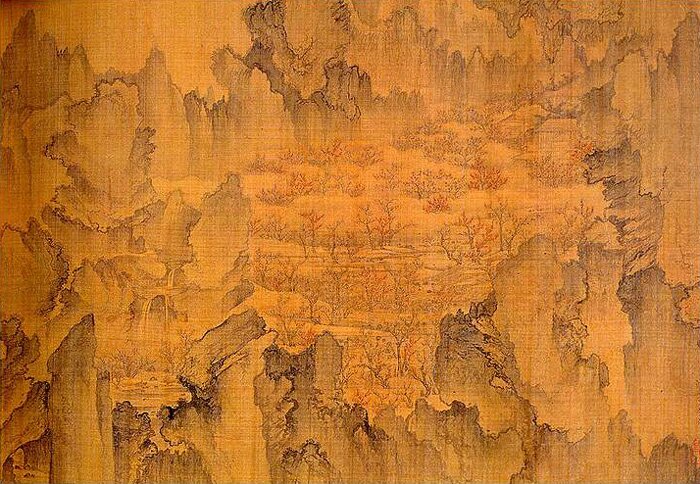
Another painter of the Joseon period, Ahn Gyeon was also a member of the Dohwaseo. As an official painter of the Joseon court, he was charged with painting a portrait of Mongyu dowondo for Prince Anpyeong. The painting, which was completed in 1447, is housed at Tenri University.
Prince Anpyeong is also the inspiration behind the painting, “A Dream of Amusement in the Garden of Peach Blossoms”. After hearing the recitation of a poem by a Chinese poet, it became popular belief that peach blossoms represented a peaceful existence. After having a dream about walking in a field of the fragrant blossoms, the Prince hired Ahn Gyeon to create this work.
7. Two Men Wrestle (By: Kim Hong-do)

Kim Hong-do was also very prominent during the Choson Dynasty. This late 18th century work of his depicts villagers gathering to watch a wrestling match between two men. The proper name for the painting is “Ssirum”, which translates to the word “wrestling”.
This is one of Hong-do’s most praised works. The fact that he painting depicts what commoner’s ok part in during their daily lives has always been a topic. As well, his use simple strokes and background was a change from his usual style of painting. There has often been reference to his use of numbers to create balance in the painting.
6. Joseon Dynasty (By: Owon)

Known by his pen name, Owon, Jan Seung-ep (1843-1897) painted Korea during the late Joseon Dynasty. His painting skills were honed during his young years, as an orphan. He began to perfect his skills when he resided with a Korean aristocrat by the name of Yi Ung-heon, during his 20’s. Extremely gifted in his craft, he was capable of producing works of all genres. He was one of the “3 Wons” of the Joseon period, along with Hyewon and Danwon.
The proper name of the painting is listed as “Sansu inmuldo”. When the title is translated, it means “the picture of the man in the landscape”. The paintings title is literal since it is of a man standing in the middle of a landscape.
5. Gyeondo (By: Byeon Sang- Byeok)

Byeon Sang-Byeok was a painter during the later years of the Joseon Dynasty. His ability to capture the details of the subjects of his drawings is what made him one of the most celebrated artists of his time. Working under the pen name, Hwajae, the painter’s dates of birth and death are unknown. However, it is known that he was a member of the Dohwaseo.
“Gyeondo: translates to “painting of a dog”. It is believed to have been painted in 1730. In this painting the artist captures every detail of the animal’s furry coat and makes it seem as though the dog is having a happy memory by painting it with what appears to be a smile. The detailed brush strokes give the painting such realness, it isn’t uncommon for one to have to fight the urge to stroke the animal to see if it feels as soft as it looks.
4. A View of Geumgang (By: Jeong Seon)

Also known by his pen name Gyeomjae, Jeon Seon (1676-1759) was a landscape painter from Korea. His pen name translates to “humble study”. A famous painter during the Joseon era, he was one of the artist that took the chance to separate himself from traditional Chinese styles of painting. Recommended by an aristocratic neighbor for court, he was given an official position.
The painting, “Geumgang jeondo”, is a work that depicts a landscape of North Korea. Done in ink and watercolor, the painting was created in 1734. The picture is of the Diamond Mountains. It is housed in the Ho-Am art Museum;
3. Mother Dog (By: Yi Ahm)

Yi Ahm (1507-1566) was a Korean painter during the Joseon Dynasty. This painting, “Mother Dog and Puppies”, was created in the first half of the 16th century. A mother dog is depicted in the painting, looking on lovingly as her pups rest. This painting is housed in the National Museum of Korea.
2. A Boat Ride (By: Shin Yun-bok)

Shin Yun-bok was also known by his pen name Hyewons. One of the members of the Dohwaseo for a period of time, he was an artist during the Joseon Dynasty. “A Boat Ride” was painted in 1805. The painting has also been referred to as the “Boating Party. It depicts high class men “making time” with female entertainers of lower social standing. The painting itself was intended to be satiric.
1. Portrait of a Beauty (By: Hyewon)

Hyewon’s proper name is Shin Yun-bok. Born in Korea in 1758, he was a painter during the Joseon Dynasty and one of the “3 Wons”. Hyewon’s father and grandfather were both painters and he inherited their gifts and trade. However, the erotic nature of his works caused him to be expelled from the Dohwaseo.
“Portrait of a Beauty” was painted on silk. It depicts what was the ideal standard of beauty during that era. The most noticeable feature of the painting is the realistic detail of the hanbok that the beauty is wearing. The concept of making a woman the focus of a painting at the time was considered to be revolutionary. The work has since been the inspiration of both literary work and film.
As you can see, art in Korea spans multiple genres. Where some artists specialized in landscapes, others were genius at capturing the human form. There were some who were experts at painting animals, while others used spirituality to create masterpieces. Some may find it ironic that many of the most celebrated pieces of art in Korean history are all from around the same dynasty. Not to mention that many of them were produced by artists who were good enough to work in the royal court.
It is safe to say, that the art from Korea’s past, still influences the art that is being produced by the nation today. A land of culture, many of the paintings were a source of passing along the lands history to ensure that it made it into the future. There is no surprise in seeing the same styles being used; the mix of calligraphy, inks, canvases…it’s all visible in present day artwork from Korea. And just s Korean art left its mark back then so that it would be remembered now; today’s Korean artists will do the same and be remembered in the future.
Source:http://akorra.com/2011/11/13/top-10-korean-paintings/
Sunday, April 6, 2014
Wednesday, December 25, 2013
Life in Ocean's Embrace
http://www.arirang.co.kr/Tv2/Tv_PlusHomepage_Intro.asp?PROG_CODE=TVCR0704&MENU_CODE=101801&sys_lang=Eng


Life in Ocean's Embrace
David Alan Harvey has been exploring cultural diversity and people's lives for the past 50 years. Now he's in Korea's southern coast to delve into the lives of Korea's fearless sea people. Join the renowned Magum Photos member as he embarks on an expedition to Korea’s largest port city of Busan, Tongyeong, nicknamed the Vienna of Korea, and the city of Geoje.
Haenyeo, the mysterious women of the sea
Waters off Geojedo boast pristine, stunning vistas, deserving of its status as a national marine park. In a small fishing village of Dapori located in Geojedo David finds a special breed of women. They’re the haenyeo, Korea's intrepid female divers who brave icy waters armed with only a wet suit, a pair of goggles and the simplest tools to collect shellfish from the deep. David captures these hard-working women on film.
Waters off Geojedo boast pristine, stunning vistas, deserving of its status as a national marine park. In a small fishing village of Dapori located in Geojedo David finds a special breed of women. They’re the haenyeo, Korea's intrepid female divers who brave icy waters armed with only a wet suit, a pair of goggles and the simplest tools to collect shellfish from the deep. David captures these hard-working women on film.
Dongpirang, a village saved by its murals
Tongyeong is one of the most beautiful port cities in Korea's southern coast. Dongpirang Village sitting atop a hill looking down on the entire city of Tongyeong has long been home to many common folks. But it was on the verge of being razed, because the neighborhood had become dilapidated. But the residents of Dongpirang Village banded together and drew colorful murals not only to save the village from destruction but also to turn it into a must-see attraction in Tongyeong. David joins some village residents to see the nightscape of Tongyeong from Dongpirang.
Tongyeong is one of the most beautiful port cities in Korea's southern coast. Dongpirang Village sitting atop a hill looking down on the entire city of Tongyeong has long been home to many common folks. But it was on the verge of being razed, because the neighborhood had become dilapidated. But the residents of Dongpirang Village banded together and drew colorful murals not only to save the village from destruction but also to turn it into a must-see attraction in Tongyeong. David joins some village residents to see the nightscape of Tongyeong from Dongpirang.
Oysters, a healthy gift from the winter sea
Tongyeong is Korea’s biggest producer of oysters. The city gets busy in winter as oysters are in peak season around this time of the year. David visits the bustling oyster farms in the early morning hours and the oyster shucking plant where women make the most fun out of what could be a tedious job. Then David samples some of the most delectable oyster dishes.
Busan, the narratives of back street dwellers
Ship repair yards more than a hundred years old, dubbed the general hospital for ships, dot the back streets of Busan Port. Old ships are transformed into new ones and sent out to sea. Also interesting are the narratives of the workers who have spent their lives fixing ships. This neighborhood also houses a shrine where prayers are offered to comfort the souls of those who perished in the seas.
Tongyeong is Korea’s biggest producer of oysters. The city gets busy in winter as oysters are in peak season around this time of the year. David visits the bustling oyster farms in the early morning hours and the oyster shucking plant where women make the most fun out of what could be a tedious job. Then David samples some of the most delectable oyster dishes.
Busan, the narratives of back street dwellers
Ship repair yards more than a hundred years old, dubbed the general hospital for ships, dot the back streets of Busan Port. Old ships are transformed into new ones and sent out to sea. Also interesting are the narratives of the workers who have spent their lives fixing ships. This neighborhood also houses a shrine where prayers are offered to comfort the souls of those who perished in the seas.
Chungmu Morning Market
Chungmu Morning Market is the oldest marketplace in Busan. Located near Busan Port, the market provides a resting place for sailors who come ashore only once every 15 days as well as a glimpse into the market merchants' fierce struggles to make a decent living. David captures the beautiful scenery of the pre-dawn Busan Port and people whose daily lives begin at the crack of dawn.
Chungmu Morning Market is the oldest marketplace in Busan. Located near Busan Port, the market provides a resting place for sailors who come ashore only once every 15 days as well as a glimpse into the market merchants' fierce struggles to make a decent living. David captures the beautiful scenery of the pre-dawn Busan Port and people whose daily lives begin at the crack of dawn.
Wednesday, December 18, 2013
Seowon
http://www.arirang.co.kr/Tv2/Tv_PlusHomepage_Intro.asp?PROG_CODE=TVCR0478&MENU_CODE=100980&sys_lang=Eng


Seowon
A Santuary of Well-rounded EducationThere is probably no other country in human history that has been as deeply influenced by Confucianism than Joseon.
The present economic success enjoyed by Korea has been achieved through a strong emphasis on education and pursuit of knowledge throughout society. This culture began during the Joseon Dynasty.
During the Joseon Era, scholars pursued knowledge as a way to become ethical and act in virtuous ways in contrast to present times in which Koreans seek to acquire professional knowledge and skills to accrue wealth and higher status. Literature, history and philosophy were the main focus among Joseon scholars. This was mainly due to the need to maintain an ethical and stable society in that era.
Seowon (Confucian school) was the place where knowledge was acquired and expanded in the Joseon Era. The effort to expand knowledge among scholars led to closer clanship, more prestige, and political gain.
But there was more to it than this.
- Foundation philosophy of Cheoninhabil ("The heavens and humans are one") underlies Confucian perspective of nature.
- Establishment of private institution for a whole-rounded education offered to the ruling class
- Political base camp for local Seowon schools
- Offered services akin to a local cultural center
The present economic success enjoyed by Korea has been achieved through a strong emphasis on education and pursuit of knowledge throughout society. This culture began during the Joseon Dynasty.
During the Joseon Era, scholars pursued knowledge as a way to become ethical and act in virtuous ways in contrast to present times in which Koreans seek to acquire professional knowledge and skills to accrue wealth and higher status. Literature, history and philosophy were the main focus among Joseon scholars. This was mainly due to the need to maintain an ethical and stable society in that era.
Seowon (Confucian school) was the place where knowledge was acquired and expanded in the Joseon Era. The effort to expand knowledge among scholars led to closer clanship, more prestige, and political gain.
But there was more to it than this.
- Foundation philosophy of Cheoninhabil ("The heavens and humans are one") underlies Confucian perspective of nature.
- Establishment of private institution for a whole-rounded education offered to the ruling class
- Political base camp for local Seowon schools
- Offered services akin to a local cultural center
Thus, the Seowon was a reservoir of diverse cultural content. Due to turbulent times that engulfed the Joseon kingdom at the turn of the 20th century, it was difficult for Seowon schools to maintain their institutional capabilities. Despite this, Seowon schools created intangible and tangible value that humankind should try to share and pursue today.
The history of Seowon schools that began 500 years ago has been reinterpreted in a modern perspective. The value created by Seowon schools are still applicable in present times, and it has been translated for viewers to convey its essence.
The history of Seowon schools that began 500 years ago has been reinterpreted in a modern perspective. The value created by Seowon schools are still applicable in present times, and it has been translated for viewers to convey its essence.
Wednesday, September 18, 2013
Ask a Korean!: Get Down, Get Down to the Floor
Ask a Korean!: Get Down, Get Down to the Floor: Dear Korean, Why do Koreans sometimes sleep on the floor? I mean they just put a mattress on the floor and that's it. But sometimes, ...
Subscribe to:
Posts (Atom)